
The Making of Bekooree Aneni
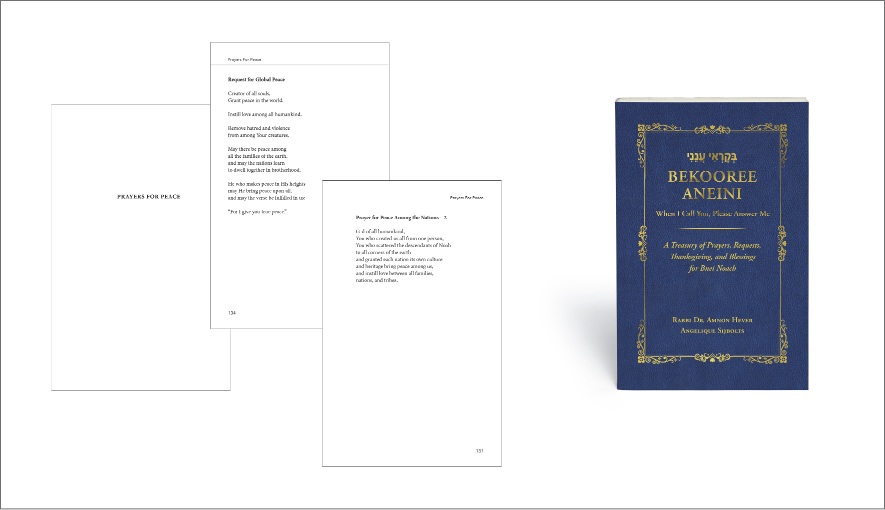
Noahides can pray to God at any moment of the day, in their own language and their own words. But sometimes it is not easy to put into words what is within us. At those moments, it can help to draw on the words of others: words that touch the heart, inspire, and offer guidance. That is exactly what the authors of Bekooree Aneini had in mind when they put this book together. Here is an interview with Angelique Sijbolts and Rabbi Amnon Hever about how Bekooree Aneini came to be.
Angelique, what was the exact moment you knew this book had to exist?
Angelique: I felt the urge to create a book that respected the desire to use prayers from the Jewish tradition, and also incorporated “free” prayers: prayers Noahides could shape in their own words, with a framework to help as a starting point. Something I had never found in all the prayer books I’d had so far. When I discussed this with Amnon, while doing translation work for him on another book, we decided it would be a wonderful project to collaborate on: he contributing his knowledge of the Jewish tradition, and I bringing my understanding of what is suitable for Noahides.
Rabbi Amnon, you could have written prayers for a Jewish audience in Hebrew. Why spend your time on a prayer book for Noahides instead?
Rabbi Amnon: I have been active for many years within the Noahide framework. It always bothered me that Noahides exist in communities separate from one another, with no connection between them, and sometimes even mutual conflicts. My goal is to create unity among Noahides, so that when a Noahide from the Netherlands meets a Noahide from Japan, they will have the common language of prayer. This is how Bekooree Aneini was born.
How did the two of you actually work together on this? What did the back-and-forth between drafting and review look like?
Angelique: It mainly consisted of discussing together what would or wouldn’t be suitable for Noahides, and which prayers we wanted to include: prayers for every day, prayers for important events, and ultimately, appropriate Psalms as well. After all, what better to use than Psalms… the universal prayer book for everyone.
What single word, phrase, or translation choice took the longest to get right, and why? Angelique: We had to be very careful to avoid using the standard “Baruch Ha…” formula. Since that phrase is appropriate for berachot or certain Jewish prayers we might have drawn upon, we sometimes easily fell into the trap of using it for our own prayers as well, only to realize each time that what we needed was not a blessing, but an expression of thanksgiving.
Rabbi Amnon: Nothing was difficult; I felt that the Master of the Universe accompanied me in my typing on the keyboard, and everything flowed to my joy and surprise, absolute wonders, otherwise I cannot understand how Bekooree Aneini was born. It is built around all stages of a person’s life, and provides an answer to almost every request or desire of a Noahide toward God. There is no prayerbook like this in existence, and we were privileged to be the first to bring it to light.
What’s in this book that doesn’t exist in any other Noahide prayer resource?
Angelique: The free-form prayers. Even though Noahides are permitted to pray in their own language and words, and formulating such prayers might not seem strictly necessary, that is precisely the strength of this book. Just as someone might use a poetry collection to find inspiration for organizing their feelings and thoughts, this prayer book aims, through these “free-form prayers,” to inspire people to eventually articulate their own thoughts and feelings more and more.
If someone had thirty seconds with this book in their hands, which page would you want open, and what would they read?
Angelique: I would like them to open the page with the “Modeh Ani.” Although it is a traditional Jewish prayer, I think it marks the beginning of every day spent with God. It is an acknowledgment that you are alive, and that God trusts you to do exactly what He created you to do that day.
What do you want someone to feel, not think, the first time they pray from this?
Angelique: I would want someone to feel that their heart finds the words to truly connect with God, for someone to genuinely feel that deep connection and the urge to say absolutely nothing to God for a moment, but simply to feel His presence.
Rabbi Amnon: Redemption and the Messiah do not depend solely on the efforts of the people of Israel to bring them about, but also on the recognition by the entire world of the Master of the Universe, the King of the Universe: “On that day the Lord will be one and His name one.” And what is more right than helping Noahides draw closer to God, speaking with God day by day, hour by hour, about everything they go through in all stages of their lives? This strengthens their personal connection and faith in God.
“Like a poetry book can help someone put their feelings into words, these prayers help people find their own words over time.”
Bekooree Aneini When I Call You, Please Answer Me
A Treasury of Prayers, Requests, Thanksgiving, and Blessings for Bnei Noach
Rabbi Dr. Amnon Hever
Angelique Sijbolts